~/research / ai-native-marketing-playbook
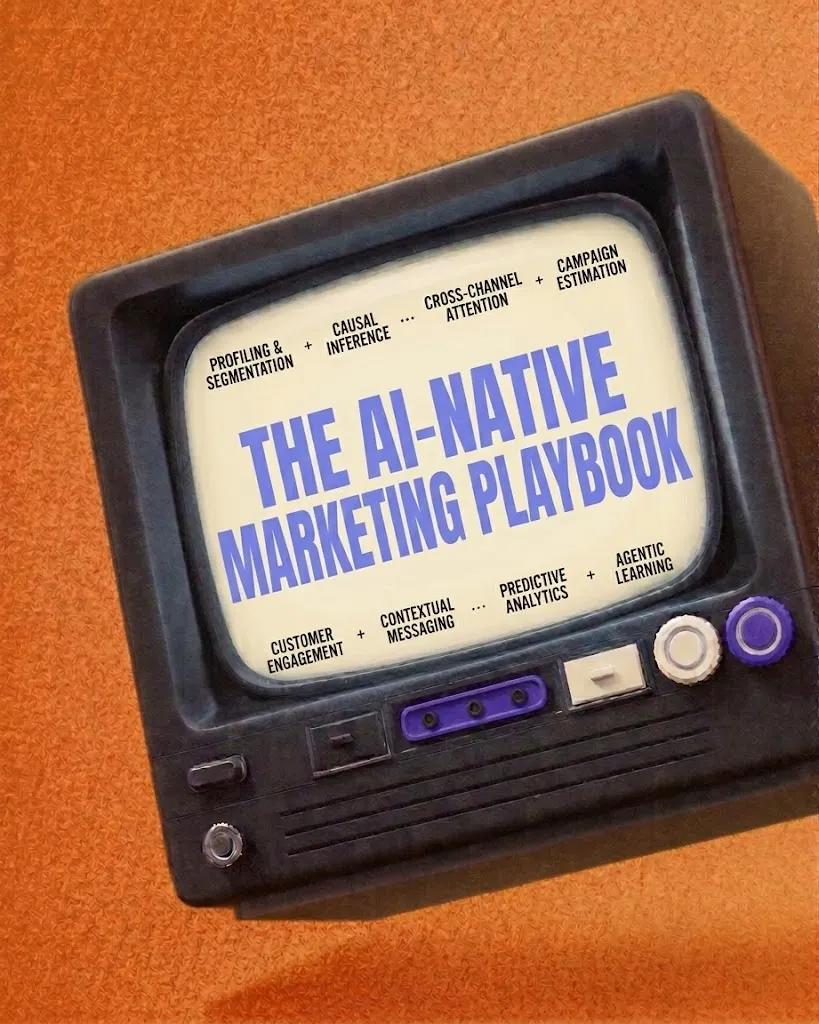
The AI-Native Marketing Playbook
What marketing looks like when AI is the substrate, not a bolt-on — the operating model, not the tool list.
What marketing looks like when AI is the substrate, not a bolt-on — the operating model, not the tool list.
AI-native marketing is an operating model, not a feature inside an old one. A bolt-on adds a smart button to a fragmented stack. AI-native rebuilds the stack as one engine that runs acquire, nurture, and retain on shared memory, operated by agents that know your brand.
Most teams have already bought AI. It writes a subject line in one tool, scores a lead in another, suggests a creative variant in a third. The model is real. The workflow it sits inside is the same one that was leaking before. A bolt-on speeds up a step without connecting the steps, so the gains stay local and the stack stays fragmented.
AI-native flips the order. The model becomes the substrate, and the workflow is built around it. No agency produces the creative, no separate tool buys the media, no team stitches the two together by Friday. There is one engine where the same agents that learn what converts also brief the next round and write the result back to memory.
The failure point both models inherit is the hand-off. That is where context dies and where marketing actually leaks, and we make the structural case for it in Monolith vs Agentic Systems. The playbook question is narrower: once you accept the engine, what does it change for the team running it?
Wonderchef is the clean test. Same brand, same category, same budget pressure. Once acquisition ran as one engine rather than a stack of tools, the numbers moved: an 8× ROAS turnaround, +166% link CTR, one SKU going from 0.05× to 3.09× ROAS, and ₹29.7L recovered in 90 days. The spend held flat. The system did the work.
The pattern repeats because the engine is brand-trained. Bombay Shaving Co. put its brand rules inside the engine and reached 68% creative approval with roughly 85% ROAS uplift, because agents that carry the brand stop producing work that gets rejected. That answers whether AI-native actually beats bolt-on: it does when the AI carries the brand and the memory, rather than sitting beside them. Both cases run on the acquisition engine, ElevateOS.
The day-to-day job changes shape. You stop coordinating vendors and start setting intent. The engine handles the motions across acquire, nurture, and retain, and you steer it.
The compounding is what most teams underestimate. Each cycle writes back what it learned, so the next one starts warm instead of cold — the mechanism we walk through in Build Loops, Not Apps. Retention rides that memory: bigbasket reached +42% funnel completion, +31% repeat orders, and +26% basket size on it. The same write-back also feeds personalisation at scale, where a different specialist does the work. On Snype, PolicyBazaar shipped 100M+ personalised creatives across seven languages for +40% CTR and +10% conversion.
This is the operating model behind the parent platform’s 200M+ customer journeys and 30%+ better ROAS. Not a smarter tool inside the old way of working, but a different way of working that happens to be intelligent end to end.
The playbook for the next five years is short. Stop buying features. Start running the engine.
Published 2026-02-18 · Whilter.AI